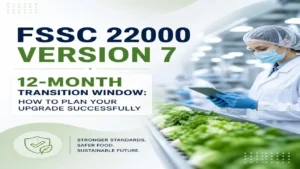
As food-safety landscapes evolve globally, certification schemes must keep pace. The FSSC 22000 scheme has announced that Version 7 is under development. FSSC+2FSSC+2 For Indian food and FMCG players—especially those working with global supply chains or seeking GFSI alignment, understanding the implications of Version 7 early gives you an operational and reputational edge. At Emaza Services we often say: compliance is not just about a certificate, it’s about readiness.
In this article we’ll cover:
- The likely direction of Version 7 (based on past versions)
- Key areas where change is expected / should prepare for
- Practical steps your business (factory, bakery, catering unit) can take now to minimise disruption
- How Emaza Services can support you through audit readiness, training, and digital tools
1. Why Version 7 is Becoming Necessary
Although the current publicly available version is Version 6 (published March 2023) and applicable for audits from April 2024. SoftExpert Blog+3FSSC+3nsf.org+3 The announcement for Version 7 shows that the scheme governance recognises the evolving risks (food fraud, sustainability, ESG, digital supply-chain) and wants to stay ahead. FSSC
In practice this means:
- Global trends (e-commerce, modular factories, smart supply-chain) raise new hazards and opportunities
- Indian market specifics (packaging change, regulation speed-up, export growth) mean local operations need to be agile
- Supply-chain transparency, environmental and social factors are now more integrated into food-safety schemes
Thus Version 7 is likely to bring stronger alignment with sustainability/ESG themes, digital traceability, supplier control and perhaps performance-based requirements rather than just procedural.
Key Expected Changes in Version 7 (And What to Watch)
While the full text of Version 7 is not yet published, based on the development path from Version 5.1 → 6 and commentary, we can anticipate certain areas of focus. These align directly with services that Emaza delivers (audits, training, procurement support). Here are five major change-areas, with implications for Indian FMCG/food businesses.
2.1 Food Safety & Quality Culture (FSQC)
Version 6 made FSQC a mandatory requirement (clause 2.5.8). FSNS – A Certified Group Company+2FSSC+2 Version 7 is very likely to elevate this further, for example: requiring measurable culture-indicators, employee engagement metrics, leadership accountability, and integration into supply-chain management.
Implications: Indian plants will need to show more than “we train staff once a year”. Expect to need dashboards/metrics for behaviour, internal audits of culture, supplier behaviour-assessments.
2.2 Increased Supply-Chain & Procurement Control
With growing outsourcing, global raw-material sourcing, and sustainability mandates (e.g., packaging, carbon footprint), Version 7 will likely require tighter controls on upstream suppliers, broker/trader responsibilities, and visibility of material flows.
Implications: From your bakery, sweet-shop or catering client perspective, you’ll need to map suppliers, perform risk-assessments of trade partners, integrate these controls into your FSMS. Emaza’s new procurement-from-partner-organisations service aligns directly with this trend.
2.3 Digitalisation, Traceability & Data-Driven Monitoring
Version 6 started to emphasise environmental monitoring, equipment management, label control etc. FSNS – A Certified Group Company+1 Version 7 may codify digital traceability (blockchain/IoT readiness), real-time monitoring, predictive analytics for food safety risk.
Implications: If your client uses manual logs, spreadsheets and feature-phone reporting, they will soon need digital dashboards, audit-trail systems, possibly cloud-based records. Emaza can train on digital audit readiness and implement tools.
2.4 Sustainability Linkages & Food Loss / Waste / ESG
Version 6 introduced requirements for food-loss & waste reduction, aligning with UN SDGs. ideagen.com Version 7 is expected to go further, integrating circular economy, packaging compliance, supplier ESG audits, and perhaps carbon/energy metrics into food-safety certification.
Implications: Your clients (especially small/medium food businesses) will need to assess waste flows, energy consumption, packaging recyclability, and integrate into their FSMS. Emaza’s training modules on sustainability and packaging (as you already have) will be relevant.
2.5 Audit Process & Scope Changes
The base scheme published that Version 7 is under development. FSSC Possible audit-process changes: extended audit durations, revised food-chain category definitions, new scopes (e-commerce, dark kitchens, ghost kitchens), remote audit allowances, more unannounced audits.
Implications: The client must prepare for potential shifts: audits may be more demanding, sampling and remote data may be used, and certification bodies may revise scoring. Early internal readiness is key.
Practical Steps for Indian Food & FMCG Businesses to Prepare
Here is a 5-step readiness roadmap tailored for your Indian SME food business clients (restaurants, bakeries, sweet-shops, catering services) working with Emaza Services.
Step 1: Conduct a Gap-Analysis Now
– Review current certification version (if certified) or FSMS maturity.
– Map what version 6 already introduced (food safety culture, digital logs, waste reduction).
– Use that as baseline so you’re in good shape when Version 7 releases.
Step 2: Strengthen Supplier Controls & Procurement Flows
– Map all suppliers (raw materials, packaging, maintenance services).
– Evaluate each for supply-chain risks (food safety, continuity, sustainability).
– Include procurement clauses, periodic audits of suppliers, traceability.
Emaza’s new “procurement sourced from partner organisations” service fits here.
Step 3: Upgrade Digital Monitoring & Documentation
– Move from paper checklists to digital tools (tablets, cloud).
– Ensure equipment calibration logs, environmental monitoring, allergen controls have data-trends and real-time visibility.
– Build dashboards for top-level management.
This positions your clients ahead of audit scrutiny.
Step 4: Embed Food Safety & Quality Culture
– Develop measurable culture objectives: e.g., number of near-misses reported by staff; frequency of culture-reviews; employee perception surveys.
– Communicate the vision: leadership messages, internal events.
– Train all levels: frontline, supervisors, maintenance.
Emaza can deliver training and culture-workshops customised for Indian SME context.
Step 5: Waste-Reduction, Packaging & Sustainability Integration
– Conduct a waste-audit: assess losses, disposal streams, energy use.
– Packaging: implement recyclability, supplier trace-back, consumer communication.
– Set ESG objectives linked to your FSMS.
When Version 7 mandates these, you’re ahead.

Why Partnering with Emaza Services Makes the Difference
Here’s how Emaza Services supports your readiness for Version 7:
- Audit & Compliance Support: We help you interpret scheme changes, update SOPs, run mock audits, ensure your FSMS is upgrade-ready.
- Training & Capacity Building: From frontline workers to managers we deliver food-safety culture modules, digital tool-training, procurement-risk workshops.
- Procurement-Partner Service: With our new service of “procurement sourced from partner organisations” we help you establish robust supply-chain controls to meet the upcoming scheme requirements.
- Digital Tools & Monitoring Dashboards: We assist in implementing digital traceability, calibration logs, environmental monitoring analytics.
- Sustainability & Packaging Alignment: Our previous work in packaging, ESG-goals blends seamlessly with what Version 7 is expected to emphasise.
If you’re a food-business owner or manager in India (restaurant, bakery, catering, FMCG) and you want to stay Ahead of the Curve, now is the moment to act. Contact Emaza Services via our website to schedule a Version 7 Readiness Review. We’ll help you assess where you stand, map out the upgrade path, and align your operations with both compliance and growth.
The arrival of FSSC 22000 Version 7 is not simply another revision, it reflects a future where food-safety systems are deeply integrated with supplier ecosystems, digital intelligence, sustainability, and organisational culture. For Indian food and FMCG businesses, this creates both challenges and opportunities. By acting now with Emaza Services, you position your business not just to certify, but to excel: stronger compliance, better operations, improved brand trust.