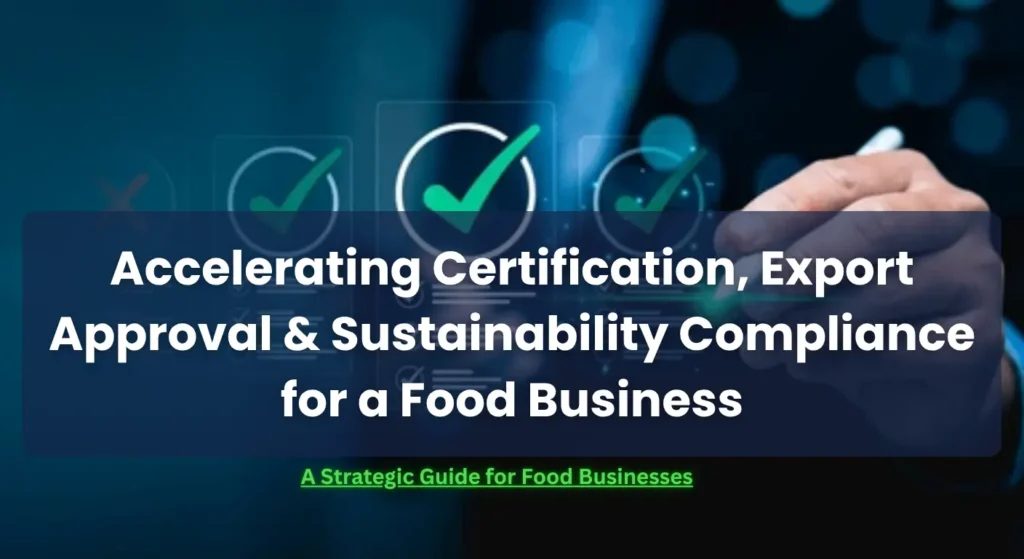
A Strategic Guide for Food Businesses
Introduction
In today’s highly regulated and competitive food industry, achieving certification and securing export approvals is no longer just a compliance requirement—it is a strategic necessity for growth. Businesses aiming to expand into global markets such as Bahrain, the United Arab Emirates, and Saudi Arabia must align with stringent food safety, quality, and sustainability standards.
From implementing HACCP principles to achieving ISO 22000 certification and complying with GFSI-recognized schemes such as BRCGS Food Safety, FSSC 22000 Version 6, and GLOBALG.A.P., the process can be complex and time-intensive.
Additionally, global buyers are increasingly demanding sustainability and ESG (Environmental, Social, and Governance) compliance, adding another layer of responsibility.
This is where professional consultants play a transformative role—helping businesses achieve faster certification, seamless export approval, and long-term compliance.
Why Certification & Export Approval Take Time
Before understanding the role of consultants, it is important to recognize the common challenges businesses face:
- Lack of clarity on requirements of HACCP & ISO series certification, GFSI-approved implementation, including BRCGS, FSSC, Global Gap, etc., implementation & Sustainability & ESG support
- Incomplete or incorrect documentation
- Weak implementation of HACCP principles
- Poor understanding of export regulations
- Labeling and compliance errors
- Audit non-conformities and repeated rework
Without proper guidance, these issues can significantly delay certification timelines and market entry.
Role of Consultants in Certification & Export
Consultants bring technical expertise, industry experience, and structured methodologies to simplify complex compliance requirements.
They act as
- Advisors (strategy & planning)
- Implementers (system development)
- Trainers (capacity building)
- Auditors (readiness assessment)
- Compliance partners (export & regulatory support)
1. Comprehensive Gap Analysis & Roadmap
The process begins with a detailed assessment against:
- HACCP
- ISO 22000
- FSSC 22000 Version 6
- BRCGS Food Safety
- GLOBALG.A.P.
Outcome:
- Identification of gaps and risks
- Customized implementation roadmap
- Defined timelines for certification and export readiness
This eliminates confusion and accelerates execution.
2. HACCP & Food Safety System Implementation
Consultants design and implement robust food safety systems by:
- Conducting hazard analysis
- Identifying Critical Control Points (CCPs)
- Establishing monitoring and verification systems
- Implementing PRPs and operational controls
Result:
- Strong foundation for all certifications
- Improved product safety and compliance
3. ISO & GFSI Certification Support
Achieving certification requires both documentation and implementation.
Consultants provide:
- Development of Food Safety Manuals and SOPs
- Alignment with the ISO 22000 framework
- Integration with FSSC 22000 Version 6
- Preparation for BRCGS Food Safety audits
- Support for GLOBALG.A.P. implementation (for primary production)
Benefit:
- Faster certification timelines
- Higher success rate in the first audit
4. Export Compliance & Market Entry Support
Certification alone is not enough—export markets have additional requirements.
Consultants assist with:
- Product registration and approvals
- Documentation (health certificates, declarations)
- Label compliance as per the overseas countries’ requirements
- Arabic labeling requirements
- Shelf-life validation
Impact:
- Smooth customs clearance
- Reduced shipment rejection
- Faster market entry
5. Labeling & Regulatory Compliance
Incorrect labeling is one of the top reasons for export rejection.
Consultants ensure:
- Accurate ingredient and allergen declaration
- Correct date format and shelf life
- Bilingual (Arabic/French and English) labels
- Compliance with country-specific regulations
6. Sustainability & ESG Integration
Modern buyers expect more than compliance—they demand responsible practices.
Consultants support:
- Environmental monitoring (energy, water, waste)
- Sustainable sourcing practices
- ESG policy development
- Documentation and reporting
Outcome:
- Enhanced brand credibility
- Better acceptance by international buyers
- Alignment with global sustainability trends
7. Training & Competency Development
A system is only as strong as the people implementing it.
Consultants provide:
- HACCP training
- Internal auditor training
- Hygiene and operational training
- ESG awareness programs
Result:
- Skilled workforce
- Strong food safety culture
- Reduced operational errors
8. Audit Readiness & Mock Audits
Consultants prepare businesses for certification audits through:
- Internal audits
- Pre-assessment checks
- Documentation review
- CAPA (Corrective Action) support
Impact:
- Higher audit success rate
- Faster certification
- Reduced non-conformities
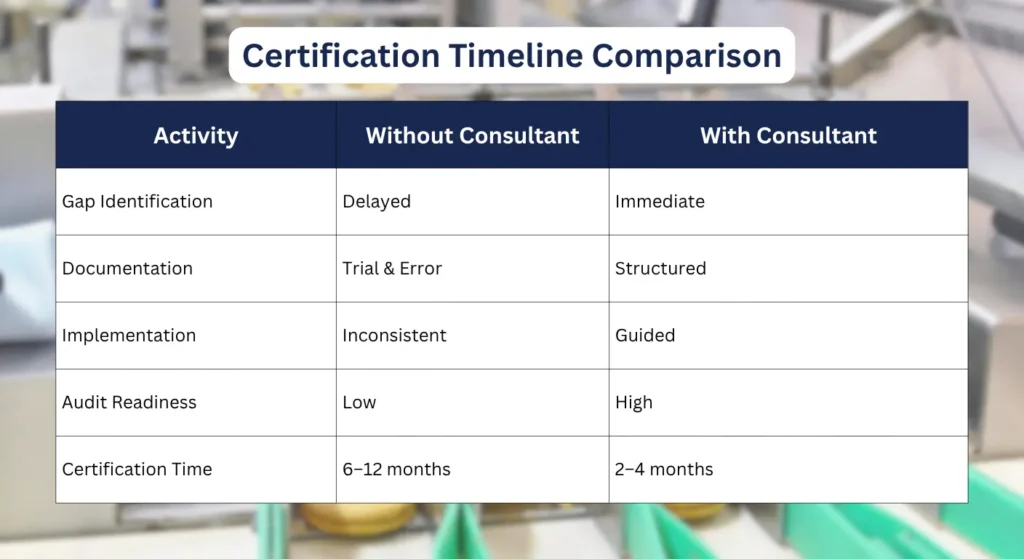
9. Case Example
Fast-Track Certification & Export Approval
A food manufacturing company aimed to export to overseas countries but faced delays due to:
- Incomplete HACCP plan
- Incorrect labeling
- Audit non-conformities
With consultant support:
- Achieved ISO 22000 in 3 months
- Developed GCC-compliant labels
- Cleared export approvals without rejection
- Entered the Bahrain and UAE markets successfully
Challenges Without Expert Guidance
Businesses attempting certification independently often face:
- Misinterpretation of standards
- Poor documentation quality
- Repeated audit failures
- Export shipment rejection
- Increased cost and delays
10. Business Benefits of Consulting Support
Operational Benefits:
- Improved process control
- Better traceability
- Reduced risks
Market Benefits:
- Faster export approvals
- Access to global markets
- Increased buyer confidence
Financial Benefits:
- Reduced rework and audit failures
- Lower compliance costs
- Faster ROI
Conclusion
Achieving certification and export approval in today’s food industry requires more than basic compliance—it demands a structured, strategic, and integrated approach. From implementing HACCP and ISO systems to achieving GFSI certifications and aligning with ESG expectations, the journey can be complex without expert guidance.
Professional consultants simplify this journey by providing the expertise, systems, and support needed to achieve faster certification, seamless export approval, and sustainable growth.
How Emaza Services Can Help
Emaza Services Pvt. Ltd. offers end-to-end solutions for:
- HACCP & ISO 22000 implementation
- GFSI certifications: BRCGS Food Safety, FSSC 22000 Version 6, GLOBALG.A.P.
- Export compliance & GCC labeling
- Sustainability & ESG advisory
- Audit preparation and CAPA closure
Partner with us to accelerate your certification journey, ensure export success, and build a future-ready food business.