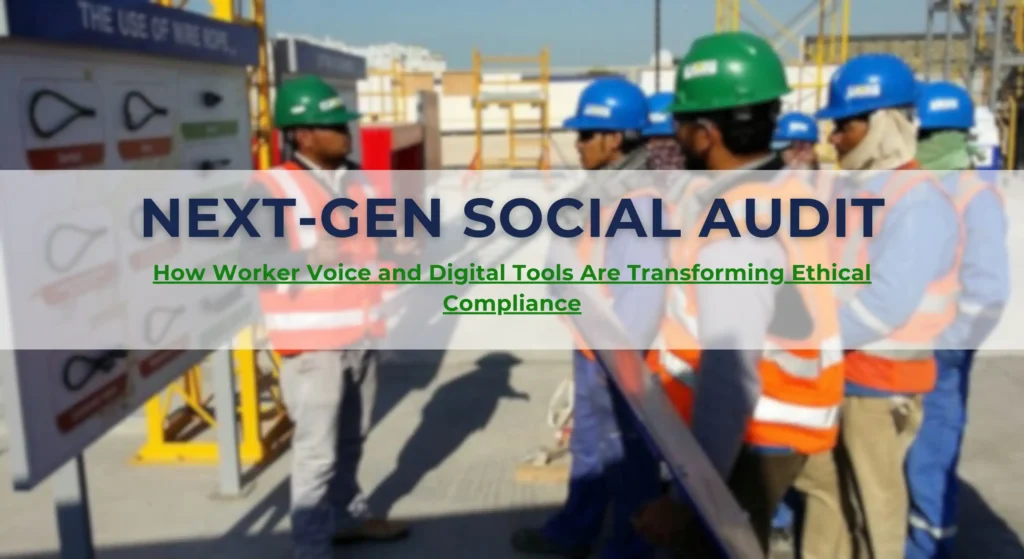
How Worker Voice and Digital Tools Are Transforming Ethical Compliance
Introduction
Traditional social compliance audits have long been central to evaluating labor standards, human rights, and ethical sourcing in global supply chains. However, evolving regulatory expectations and buyer demands have exposed limitations in traditional audit models, which are periodic, checklist-based, and often detached from real worker experience.
A new era of digital, worker-centric auditing tools is emerging. Leading sustainability platforms now incorporate real-time worker feedback and anonymous grievance mechanisms to surface human-rights issues that might escape traditional audits. Among these innovations, EcoVadis Worker Voice has become a recognized leader in enabling continuous worker feedback and more proactive ethical compliance. EcoVadis+1
This article examines these developments, their relevance under modern human-rights due diligence regulations, and practical readiness steps for suppliers and compliance teams.
The Limits of Traditional Social Audits
Standard social compliance or ethical audits typically:
• Occur irregularly (annual or semi-annual)
• Rely on document reviews and formal interviews
• Capture a snapshot in time
• Depend on auditor availability and access
While valuable, such audits may miss ongoing issues such as unsafe working conditions, forced overtime, harassment, or retaliation risk, particularly at indirect supplier tiers. Independent ethical audits (e.g., SMETA, BSCI) are still widely used, but by themselves they may not reveal the day-to-day worker experience within complex supply chains. QIMA
Introducing Worker Voice
Real-Time Worker Feedback for Ethical Compliance
To address these gaps, sustainability intelligence providers have developed digital worker engagement platforms. EcoVadis Worker Voice (launched in partnership with Ulula) enables anonymous, accessible, real-time feedback directly from supply-chain workers. It uses mobile surveys, SMS, web interfaces and other channels suited to workers’ technological reach. EcoVadis+1
Key features include:
• Anonymous worker responses without fear of retaliation
• Multi-channel accessibility (mobile, SMS, web, QR)
• Real-time insights and analytics for risk prioritization
• Multi-language support to broaden participation
• Dashboard monitoring for buyers and suppliers
These features allow organizations to detect potential issues earlier, with data that complements traditional audits and supports continuous human-rights due diligence. EcoVadis+1
Why Worker Voice Matters
Enhanced Risk Detection
Real worker insights can reveal issues that aren’t evident in paperwork or missed during scheduled audits. By surfacing concerns directly from employees, firms gain actionable data on working conditions, safety issues, and labor rights violations long before they escalate.
Continuous Compliance
Modern regulatory frameworks such as the EU’s Corporate Sustainability Due Diligence Directive (CSDDD) and country-specific labour laws (e.g., UK Modern Slavery Act) emphasize ongoing human-rights due diligence, not just periodic assessments. Worker Voice tools help fulfill these expectations by providing continuous evidence of risk identification and remediation efforts.
Buyer and Retailer Confidence
Leading global retailers and procurement teams now look for dynamic evidence of social responsibility, not just audit certificates. Real-time worker feedback demonstrates a supplier’s commitment to transparency and actionable compliance.
How Worker Voice Works Across Supply Chains
Platforms like Worker Voice provide a 360-degree view of labor conditions by integrating technology designed to overcome traditional barriers:
• Accessibility even where smartphones are not ubiquitous (via SMS or QR links)
• Anonymous reporting to encourage honest worker participation
• Real-time dashboards that track trends and highlight risk clusters
• Analytics that help prioritize remediation actions
According to industry reports, such tools are active in numerous languages and countries, making them applicable even in geographically dispersed value chains. EcoVadis
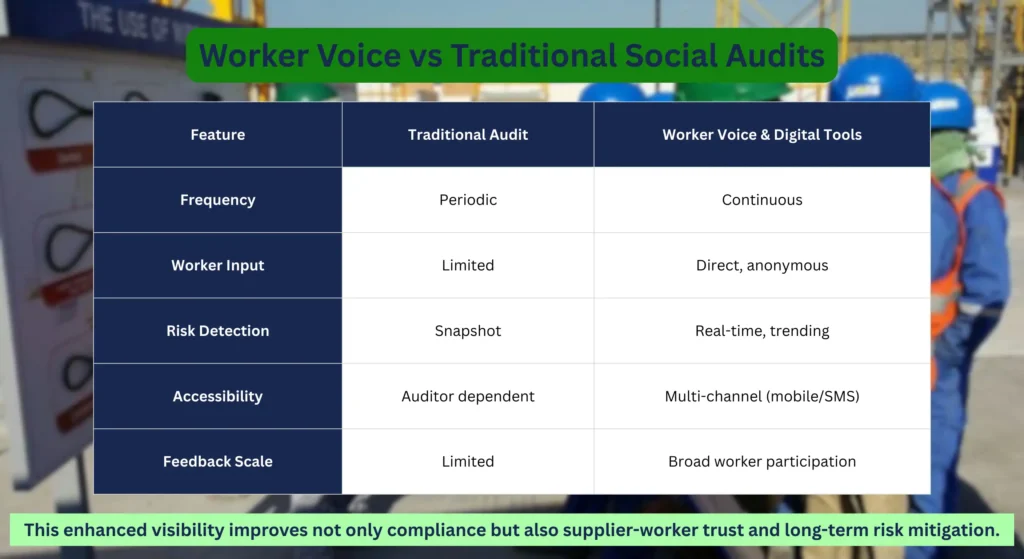
Worker Voice vs Traditional Social Audits
| Feature | Traditional Audit | Worker Voice & Digital Tools |
| Frequency | Periodic | Continuous |
| Worker Input | Limited | Direct, anonymous |
| Risk Detection | Snapshot | Real-time, trending |
| Accessibility | Auditor dependent | Multi-channel (mobile/SMS) |
| Feedback Scale | Limited | Broad worker participation |
This enhanced visibility improves not only compliance but also supplier-worker trust and long-term risk mitigation.
Regulatory Context and Worker Voice
Worker Voice directly supports compliance with global human-rights due diligence laws and guidelines:
• EU CSDDD requires identification and mitigation of adverse labor and human-rights impacts
• UK Modern Slavery Act encourages transparent reporting on forced labor and worker exploitation
• OECD Due Diligence Guidance calls for meaningful engagement with workers
By capturing real worker experiences, companies strengthen their documented compliance evidence and demonstrate proactive risk management beyond routine audits.
Practical Readiness for Suppliers
To be prepared for next-gen ethical audits and worker feedback mechanisms, suppliers should:
- Enable Anonymous Feedback Channels
Implement mechanisms that allow workers to share concerns without risk of retaliation. - Train Workers on Reporting Options
Educate workers on how to participate in surveys, SMS feedback systems, and digital reporting tools. - Monitor and Respond to Feedback Reports
Establish protocols to triage and act on worker feedback quickly. - Integrate Insights into Corrective Actions
Track remediation activities and outcomes to demonstrate continuous improvement. - Document Human Rights Due Diligence
Maintain logs that link worker feedback with remediation steps and audit outcomes.
Beyond Worker Voice: Worker-Driven Social Responsibility
Worker-driven social responsibility (WSR) is an emerging model where workers play a central role in monitoring and enforcing rights within supply chains—often integrating structured feedback and grievance mechanisms as part of legally binding agreements. This model has been shown to produce consistent improvements in worker conditions and trust within value chains. Wikipedia+1
Conclusion
Next-generation social audits are reshaping how companies understand and manage ethical compliance. By combining traditional audit methods with real-time worker feedback tools such as EcoVadis Worker Voice, organizations can gain deeper, more accurate insights into labor conditions across global supply chains. This approach not only supports compliance with evolving human-rights due diligence laws but also strengthens buyer confidence and supplier performance.
Emaza Services Pvt. Ltd. helps organizations design, implement and manage ethical audit readiness programs that incorporate digital worker engagement tools, corrective action tracking and continuous compliance monitoring.
Sources
• EcoVadis Worker Voice Connect for supply chain accountability: Business Wire press release on EcoVadis Worker Voice Connect launch. Business Wire
• Worker Voice capabilities and real-time insights: Corporate Compliance Insights article on EcoVadis Worker Voice Connect. Corporate Compliance Insights
• Real-time worker feedback insights and supply chain transparency: TriplePundit article on Worker Voice platform. triplepundit.com
• Increased visibility into social sustainability through direct worker engagement: EcoVadis blog on Worker Voice. EcoVadis
• Role of social compliance audits and ethical audit basics: QIMA explanation of ethical/social compliance audits. QIMA
• Worker-driven social responsibility model and effectiveness: Wikipedia on Fair Food Program with worker-driven model evidence. Wikipedia
• Worker-driven social responsibility model definition and worker empowerment: Wikipedia on Worker-Driven Social Responsibility. Wikipedia